Dyson Big Ball vs Miele C1: Which Vacuum Fits You? (November 2026)
The Miele Classic C1 Pure Suction wins overall for most homes. In this Dyson Big Ball vs Miele C1 matchup, the Miele brings six suction settings and three-stage AirClean filtration, while the Dyson answers with a self-righting ball and a 10-foot hose.
On this page (10 sections)
- The quick verdict: which one fits most people?
- Dyson Big Ball vs Miele C1: the two side by side
- Suction control: six settings versus one strong pull
- Filtration and air quality: which keeps dust in the machine?
- Maneuverability: the Dyson ball against the Miele canister
- Carpet and hard floors: which head suits your home?
- Bagged versus bagless: which upkeep suits you?
- Weight, noise and storage: the everyday practicalities
- Who should buy which vacuum?
- The verdict: Dyson Big Ball or Miele C1?
The Miele Classic C1 Pure Suction wins this Dyson Big Ball vs Miele C1 comparison for most homes. It pairs six suction settings with Miele's three-stage AirClean filtration and a set of three cleaning tools, and it does that at 12 pounds.
The Dyson Big Ball Multi Floor is not a weak rival. Its ball turns on the spot, stands itself up when knocked over and carries a 10-foot hose.
That matters in open rooms where you circle furniture all the time.
The real question in the Dyson Big Ball vacuum vs Miele C1 decision is what your floors and your routine demand. This comparison covers the specs that change daily use, the filtration, the hose reach, the noise and the upkeep.
 Best for hard floors and low-pile carpet
Miele Classic C1 Pure Suction
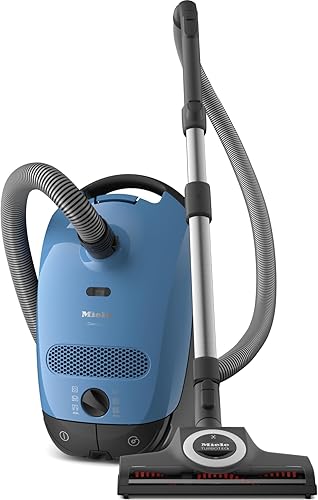
The quick verdict: which one fits most people?
Pick the Miele Classic C1 Pure Suction if you have hard floors and low-pile carpet and want control over suction. It is the highest-scored vacuum in this matchup at 8.7, and its six power settings let you drop suction for rugs and curtains and raise it for smooth tile.
Pick the Dyson Big Ball Multi Floor if maneuvering around furniture is your biggest frustration. The ball design turns in place, self-rights when toppled and follows you around a room without awkward pivoting.
That convenience is real, and the Dyson still lists a five-year parts and labor warranty.
The Miele Classic C1 Turbo Team is the middle option at 8.6. It adds a turbo floorhead for low to medium-pile carpet while keeping a separate parquet head for hard floors.
If you want the wider brand picture first, our Dyson vs Miele comparison looks at how the two makers approach stick and canister models.
Dyson Big Ball vs Miele C1: the two side by side
The table below puts the three vacuums next to each other on the specs that affect daily cleaning. Read it before you choose a form factor, because weight and hose reach change how often you pull the vacuum out.
| Spec | Miele Classic C1 Pure Suction | Miele Classic C1 Turbo Team | Dyson Big Ball Multi Floor |
|---|---|---|---|
| Weight | 12 lb | 13 lb | 8 kg (about 17.6 lb) |
| Bag capacity | 4.76 qt | 4.5 qt | 1.6 liters |
| Noise level | 64 db | 60 db | 78 db |
| Suction settings | 6 | 6 | Push button control |
| Filtration | AirClean 3-tier | Miele AirClean Filter | Non-washable post-motor filter |
| Floorheads | SBD 365-3 Combination | STB 305-3 TurboTeQ plus SBB Parquet-3 | Carbon fiber Turbine head plus combination tool |
| Hose | 3.6 yd (about 10.8 ft) | 3.6 yd (about 10.8 ft) | 10 ft |
| Warranty | 1 year limited | 1 year limited | 5 years parts and labor |
The table tells a clear story. The Miele pair gives you more suction control, more bag volume and quieter running.
The Dyson gives you the longest warranty and the lightest steering.
The weight gap is the one that surprises people. At about 17.6 pounds, the Dyson Big Ball is roughly 5 pounds heavier than the Pure Suction, and you feel that on stairs and when lifting it over thresholds.
Suction control: six settings versus one strong pull
The Miele Classic C1 vacuums win this point. Both list six suction power settings that you switch to match the surface, so you can dial down for a delicate rug and turn it up for hard flooring.
That control matters more than raw power for most homes. A vacuum that pulls hard on every surface can grab curtains, suck down lightweight rugs and pull at the edges of area carpets.
The Dyson Big Ball Multi Floor uses push button controls rather than numbered power levels. Dyson's answer is a carbon fiber Turbine head whose stiff nylon bristles remove ground-in dirt while the filaments pick up fine dust.
Neither approach is wrong. If you clean a mix of surfaces and want to adjust as you go, the Miele settings are the more useful tool.
If you mostly vacuum the same flooring and want to push and go, the Dyson head does the work without dialing.
If you are weighing whether the Dyson premium is justified at all, our post on whether Dyson vacuums are worth it breaks down what you pay for.
Filtration and air quality: which keeps dust in the machine?
The Miele AirClean system is the stronger filtration story here. It uses three tiers: a genuine Miele FilterBag, a Motor Protection Filter and an AirClean Exhaust Filter.
Miele says the room air is cleaner after vacuuming than before.
That is a maker claim, not an independent test. Still, the design matters for allergy season.
A sealed bag captures dust and holds it until you remove the bag, so emptying the vacuum does not send a cloud back into the room.
The Dyson Big Ball Multi Floor uses a non-washable post-motor filter. It is bagless, and Dyson says the hygienic dirt ejector drives out trapped dust and debris as you empty it, so you do not touch the dirt.
That is a convenience feature rather than a filtration upgrade.
For a home with pets or seasonal allergies, the bagged Miele approach is easier to live with. For a home that wants to skip buying bags and empty a bin into the trash in one motion, the Dyson fits better.
Maneuverability: the Dyson ball against the Miele canister
The Dyson Big Ball wins on steering. Its ball houses the core components and turns on the spot, so it follows you around furniture without the awkward pivoting a traditional canister needs.
Dyson also says it self-rights when toppled, so it stands back up instead of lying on its side.
The Miele Classic C1 models are conventional canisters. Miele's own description is honest about the trade: you vacuum around and under furniture and use the clipped-on accessories for upholstery and hard-to-reach spots.
That works well, but it takes more wrist work than a ball.
The hose figures favor the Miele slightly. The Dyson lists a 10-foot hose, while the Miele lists 3.6 yards, which works out to about 10.8 feet.
In practice both reach across a room, so base your choice on steering rather than hose length alone.
One more difference sits in the box. The Pure Suction ships with an SBD 365-3 Combination Floorhead, a dusting brush, a crevice tool and an upholstery tool.
The Dyson Big Ball comes with a combination tool and a stair tool.
Carpet and hard floors: which head suits your home?
Match the head to your carpet before you match the brand. The Miele Classic C1 Pure Suction is built for hard floors and low-pile carpet, and its combination floorhead switches between the two.
The Miele Classic C1 Turbo Team goes a step further. It ships with an STB 305-3 TurboTeQ floorhead for low to medium-pile carpet plus an SBB Parquet-3 floorhead for hard floors.
If your home has a medium-pile area rug in one room and tile everywhere else, this is the Miele to choose.
The Dyson Big Ball Multi Floor's carbon fiber Turbine head is designed for mixed flooring. Dyson says the filaments pick up fine dust and the stiff nylon bristles remove ground-in dirt.
Its combination tool handles hard surfaces.
If you have deep-pile or high-pile carpet, neither Miele C1 here is the right tool. The Turbo Team's head is rated for low to medium-pile carpet, and the Pure Suction stops at low-pile.
Step up to a model with an electric powerhead for thick carpet.
If you are still deciding between a canister and an upright for your home, our guide on canister vs upright vacuums covers the floor plan and storage differences.
Bagged versus bagless: which upkeep suits you?
Choose the Miele if you would rather swap a bag than empty a bin; choose the Dyson if touching dirt is the thing you want to avoid. This is a lifestyle call more than a cleaning one.
The Miele Classic C1 models are bagged. The Pure Suction has a 4.76-quart bag and the Turbo Team has a 4.5-quart bag.
Larger bags mean fewer changes, and the bag holds dust until you lift it out. Replacement bags are a running cost you plan for.
The Dyson Big Ball Multi Floor is bagless with a 1.6-liter capacity. Its dirt ejector empties the bin without contact, which is the feature that sells it to people who dislike the bin routine.
The bin is smaller than either Miele bag, so it fills sooner.
The Miele filtration relies on the bag as its first tier. That means bag quality matters, and genuine Miele FilterBags are the intended part.
The Dyson's filter is non-washable, so plan on replacements rather than rinsing it.
Weight, noise and storage: the everyday practicalities
The Pure Suction is the easiest of the three to carry and store, and the Turbo Team is the quietest. The Dyson is the heaviest and loudest, which matters in apartments and open-plan homes.
The weight figures are 12 pounds for the Pure Suction, 13 pounds for the Turbo Team and about 17.6 pounds for the Dyson Big Ball. A 5-pound gap sounds small on paper, but it shows up on stairs and when you lift the vacuum onto a shelf.
Noise is rated at 64 db for the Pure Suction, 60 db for the Turbo Team and 78 db for the Dyson. An 18 db gap is a big jump.
If you vacuum while someone works from home or sleeps in the next room, the Miele is the more considerate choice.
All three are canisters, so storage means a body plus a hose. The Miele models measure 18.2 by 11 by 8.7 inches.
The Dyson measures 15.7 by 12.1 by 13.7 inches. Neither shape is dramatically easier to tuck into a closet.
The Dyson's warranty is the outlier. Dyson backs the Big Ball with five years of parts and labor.
Both Miele Classic C1 models carry a one-year limited warranty. That is a real reason some buyers lean Dyson.
Who should buy which vacuum?
Buy the Miele Classic C1 Pure Suction if you have hard floors and low-pile carpet and want suction control plus sealed filtration. It is the best overall pick in this matchup, it is the lightest of the three and it covers smooth flooring plus rugs with one combination head.
Buy the Miele Classic C1 Turbo Team if your home mixes hard floors with low to medium-pile carpet. The turbo floorhead is the reason to spend more than the Pure Suction here, and its 60 db rating makes it the quietest option.
Buy the Dyson Big Ball Multi Floor if you vacuum large open rooms with lots of furniture and want the vacuum to steer itself. The ball turns on the spot, the unit stands back up when knocked over and the dirt ejector keeps your hands clean.
The five-year warranty adds peace of mind.
Skip the Dyson if you have thick carpet. Its turbine head is not built for deep pile.
Skip the Pure Suction if you have medium-pile carpet anywhere, since the Turbo Team's head is the one rated for it.
If you are also considering a stick vacuum for quick pickups, our Dyson vs Shark comparison helps you sort out the stick category before you commit to a canister.
The verdict: Dyson Big Ball or Miele C1?
The Miele Classic C1 Pure Suction is the better vacuum for most readers in this Dyson Big Ball vs Miele C1 decision. Six suction settings, three-stage AirClean filtration, a 4.76-quart bag and a 12-pound body make it the more controlled and more comfortable tool for hard floors and low-pile carpet.
Choose the Miele Classic C1 Turbo Team instead if you have low to medium-pile carpet alongside hard floors. Its turbo head and parquet head cover both surfaces, and its 60 db rating is the quietest in this group.
Choose the Dyson Big Ball Multi Floor only if maneuverability is your top priority. The ball steering, self-righting body, dirt ejector and five-year warranty are genuine advantages.
They come with more weight, more noise and less suction control.
Start with your flooring. If most of your home is hard floor with low-pile rugs, the Miele Classic C1 Pure Suction is the vacuum to buy.
If your rooms are carpeted up to medium pile, the Turbo Team is the smarter Miele. If your home is open plan and you clean around furniture constantly, the Dyson Big Ball earns its place.
Frequently asked questions
Does the Dyson Big Ball work on hard floors?
Yes. The Dyson Big Ball Multi Floor ships with a combination tool and a carbon fiber Turbine head, and Dyson says the stiff nylon bristles lift ground-in dirt.
The Miele Classic C1 vacuums are tuned for hard floors and low-pile carpet, so both handle smooth flooring.
Do both vacuums use bags?
No. The two Miele Classic C1 vacuums are bagged canisters that use genuine Miele FilterBags, and their AirClean system relies on the bag plus two filters.
The Dyson Big Ball Multi Floor is bagless and empties through a hygienic dirt ejector.
Which has the longer hose, the Dyson Big Ball or the Miele C1?
The Dyson Big Ball Multi Floor has a 10-foot hose, while the Miele Classic C1 models carry a 3.6-yard hose, which is about 10.8 feet. Measure your rooms and stairs rather than assuming one reach is always longer.


